
































Expert opinion on the floor screed
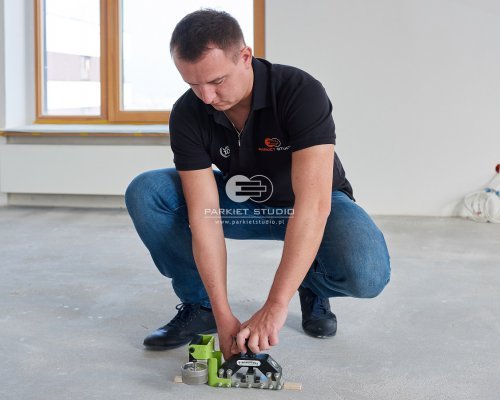
Screed Inspection and Moisture Measurement
Proper installation of wooden flooring requires thorough preparation of the substrate. During the free measurement service, our technician checks, among other things, the moisture content and strength of the screed, assesses its evenness and, using modern measuring equipment, measures the conditions in the room, including temperature and air humidity. One of the key aspects of screed inspection is a precise assessment of its hardness and cohesion, as an insufficiently compact or excessively dusty substrate can lead to the parquet becoming detached from the screed.
Before installing wooden flooring, the screed should be:
- Dry – the maximum moisture content for cement screeds without underfloor heating is 2% CM, while for anhydrite screeds without underfloor heating it is 0.5%. For cement screeds with underfloor heating, the maximum moisture content is 1.8% CM, and for anhydrite screeds with underfloor heating it is 0.3%.
- Sound and even – free from cracks and significant irregularities.
- Cohesive – the screed should have sufficient cohesion and show no tendency to delaminate.
- Hard – the hardness of the screed should be appropriate for the type of flooring to be installed.
- Level – the maximum permitted deviation is 2 mm over 1 m or 3 mm over 2 m, while the total deviation across the entire length or width of the room must not exceed 5 mm. If greater irregularities are found, they should be ground down before the flooring is installed.
The correct screed parameters are essential for the comfort, performance and long-term durability of wooden flooring. As an experienced flooring contractor, we work with several installation systems, allowing us to provide solutions tailored to the individual requirements of each project. We focus on ensuring maximum durability of the installed wooden flooring and therefore recommend the most appropriate installation system based on the condition of the screed.
Measuring Screed Moisture
Accurate measurement of screed moisture is essential before installing wooden flooring, which is why we pay particular attention to it during the initial assessment. Based on the measurement results, we determine whether installation can proceed or whether additional measures, such as drying the screed, are required.
Before installation begins, our technician assesses the moisture content of the screed using the CM method (carbide method), one of the most widely used methods for measuring substrate moisture. CM measurements are performed using a CM moisture meter, which works through a chemical reaction between calcium carbide and the water contained in the screed. This reaction produces acetylene gas, increasing the pressure inside a sealed steel vessel. The moisture content of the screed is then determined from the pressure reading shown on the gauge attached to the vessel.
The measurement begins by making a small opening in the screed using a hammer and chisel. A drill or other powered tool should not be used, as this may affect the accuracy of the measurement. The opening is typically approximately 2.5–3 cm deep, while the total screed thickness is usually around 5 cm. The opening allows a sample to be taken from the lower part of the screed. The sample is collected using a metal spoon, placed on a tray and thoroughly crushed. All work should be carried out while wearing protective gloves to avoid contaminating the sample and affecting the test results.
Once the sample has been crushed, 20 g of material is weighed and placed in the steel vessel together with a calcium carbide ampoule and metal balls. The vessel is then tightly sealed and vigorously shaken for approximately 2–3 minutes. During shaking, the metal balls break the ampoule, initiating the chemical reaction. After approximately two minutes, the vessel is shaken again and then left for around 20 minutes to allow the reaction to stabilise. The pressure reading is then taken from the gauge.
The higher the moisture content of the screed, the greater the amount of gas produced during the reaction and, consequently, the higher the pressure reading.
In addition to the CM method, screed moisture can also be assessed using other specialised measurement methods and equipment. Depending on the requirements of the project, Parkiet Studio's experienced technicians use the CM method, GANN electronic moisture meters and other professional measuring equipment to assess substrate moisture accurately.
If the measured screed moisture exceeds the accepted limits, the substrate must be brought to the required condition before installation can proceed. Depending on the circumstances, this may involve applying a suitable moisture barrier system with the appropriate primer or using dehumidifiers to accelerate the drying process.
Checking Shear Strength
During the screed inspection, it is also important to assess its shear strength. As a general guideline, the shear strength should not be lower than 2 N/mm². Shear strength can be tested using a PressoMess meter, which allows the resistance of the substrate to be assessed.
The device is positioned between two wooden blocks that are bonded to the substrate using cyanoacrylate adhesive. A control knob is then turned to gradually increase the force applied to the blocks. The measurement ends when one of the blocks is sheared from the substrate. The force recorded at the moment of failure is then read from the analogue gauge.
Two types of blocks are used for these measurements – long and short. Their dimensions and spacing are precisely specified by the manufacturer, ensuring consistent and reliable test results.
Although current regulations do not define a single mandatory value for the required shear strength of screeds, the test results provide our technicians with valuable information that helps them select the appropriate primer and adhesive system for installing wooden flooring.
Proper assessment of the screed before installation is one of the most important factors in ensuring the long-term stability, durability and performance of a wooden floor.